


Which medication can defeat cancer? What dose achieves the desired result without side effects? Above what limit does the beneficial medication turn
Which medication can defeat cancer? What dose achieves the desired result without side effects? Above what limit does the beneficial medication turn toxic? Today, such questions are answered in test series with cell cultures. They are among the most important methods in medical research.
The limit of viability Rescue lives, cure diseases, alleviate symptoms – that is what modern medications do a million times over, day after day. But we are far from having a medicine for every complaint. Moreover, corona has made us keenly aware that new illnesses are constantly joining those which are already known. New medications are, thus, constantly needed, and development work on them is ongoing. These medicines should, of course, be both effective as well as safe – ideally even before they are tested on humans. This last phase – the clinical trial phase – is essential. However, a great deal about the effect of a pharmaceutical product can also be determined already in the lab. Because this effect unfolds largely in the cells of the human body. As a result, a cell culture can serve as a substitute for “trying out” the medication. “We can, for example, determine the limit value above which a substance becomes toxic to the cells,” explains Márton Nagy, biotechnology developer at the Munich-based company INCYTOИ ®. “This applies not only for medications, by the way, but also for, e.g., potential environmental toxins. We place a certain quantity of the substance in the nutrient solution that contains the culture and observe how the cells respond. The quantity is then increased incrementally. Based on certain measurement data and the optical monitoring with a microscope, we can identify the point at which it becomes critical for the cells. This value can be converted to the body weight of a person. In practice, the permissible limit value for a dose is then generally defined as a fraction of this critical value.” In pharmaceutical research, many tests are performed using cancer cells. With these cells, however, the tables are turned: here, the objective is to determine which medication, and in what quantity inhibits their reproduction or completely destroys them. The observation of the cells is a multilayer and, above all, relatively time-consuming process. A single trial takes an average of approximately three days. During this period, numerous individual measurements are performed, and the cells are repeatedly photographed in short intervals. The image sequences can be merged together to create a time-lapse film that shows the course of the cell growth. Three physical quantities are examined for the measurements: oxygen content, pH value and electrical resistance of the cell layer.

Physical quantities provide information The values of these quantities are influenced by the metabolism of the cells. In a healthy state, for example, cells consume more oxygen than when they are already suffering from the (side) effect of a medication that has been introduced. The pH value behaves in a similar manner: Because cell metabolism produces acidic substances, the pH value usually drops into the acidic range. If this occurs to a reduced degree, the metabolism has been impaired. The degree of the deviation provides insight about the effect of the medication. The electrical resistance (impedance), on the other hand, increases with the number of cells. Thus, a delayed increase shows how strongly the cells are affected. Up until now, such test series required a great deal of manual work. The various steps could only be partially automated. With CYRIS ®FLOX, INCYTOИ ® has created a fully automatic device that can perform the multi-day test run without human intervention and can also fully document the results.

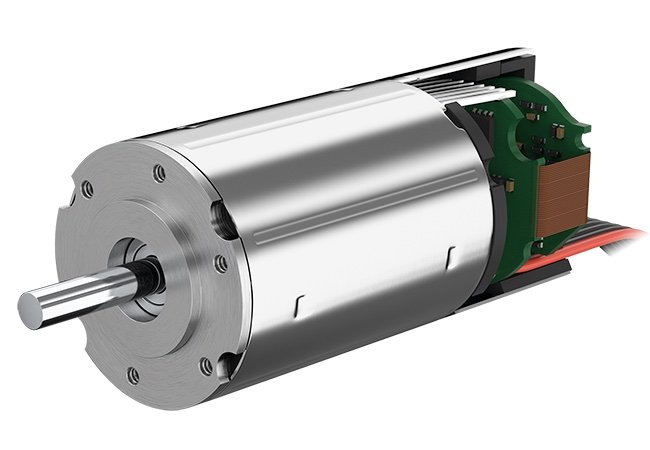
At the heart of the test setup is a microtitre plate made of transparent material that has 24 wells, or test chambers. These hold the cell samples like miniature Petri dishes. 24 pipettes on a robot arm supply the small cultures with nutrient solution and feed in the substances that are to be tested. In doing so, a different composition of the solution can be selected for each pipette. Each test chamber is equipped with sensors for oxygen content, pH value and electrical resistance. The individual test chambers are photographed from below at regular intervals through a microscope lens. Development for automation INCYTOИ ® is a start-up with academic roots. The founders of the company worked previously in university research. There, they used motors from other manufacturers for the initial prototypes of their device. These did not prove to be suitable and were later replaced by models from FAULHABER. They convinced with their compact design and the reliability of the components. When it came to the further development of the system to prepare for series production, there was, thus, no need to find a drive supplier. New goals were, however, defined for this area: “We wanted to work with as few different motor types as possible,” says Matthias Moll, head of development, describing the initial situation. “We also wanted a simpler arrangement for the wiring. We were looking for a drive in which the electronics are already integrated. Up until then, they were housed in a control element of the robot arm, which meant that many cable connections were necessary in a moving element.” In addition, the motors should be able to report errors, for example, if overheating causes or threatens to cause a mechanical blockage.

COMMENTS