


Feng Chen of Xi’an Jiaotong University in Shaanxi and Lidai Wang at the City University of Hong Kong have demo-ed cameras that can capture trillions
Feng Chen of Xi’an Jiaotong University in Shaanxi and Lidai Wang at the City University of Hong Kong have demo-ed cameras that can capture trillions of frames per second.
The researchers use a method called ‘compressive sampling’ which allows the images to ‘overlap’ on a CCD.
Their demo first sends a laser pulse containing a narrow range of frequencies through a system of lenses and a diffraction grating, which together stretch the pulse out into a “chirped pulse” of longer duration.
This pulse has higher frequencies of light at its leading edge and lower frequencies trailing behind. In addition, in order to eventually form a 2D image, the pulse is widened in the directions perpendicular to its propagation.
Following standard techniques, a pulse with this frequency structure can be used to produce multiple frames in a video because there is a precise correspondence between the frequency of light and its position within the pulse, says Chen.
If the pulse passes through some object, the scattered light can be assembled into a time-ordered video by using frequency to identify the image associated with each moment in time.
In the new imaging process, the chirped pulse interacts with an object of interest, and the scattered light then has imprinted upon it a random two-dimensional pattern before being focused onto a CCD camera.
The still frames from this pulse are written into overlapping regions of the CCD array, but the two-dimensional pattern imprinted on each image makes it possible to recover the frames with appropriate image processing.
The team demonstrated the capabilities of their method by taking pictures of a short, intense pulse of light traveling within a transparent solid. Intense light alters the refractive index of this solid material, so as the imaging laser pulse moved through, it became distorted in a way that revealed the locations of the light pulse being imaged.
Using a single chirped laser pulse, the system could produce an image every 260 femtoseconds and could generate a 60-frame video, although only 40 frames were needed to capture the moving light pulse.
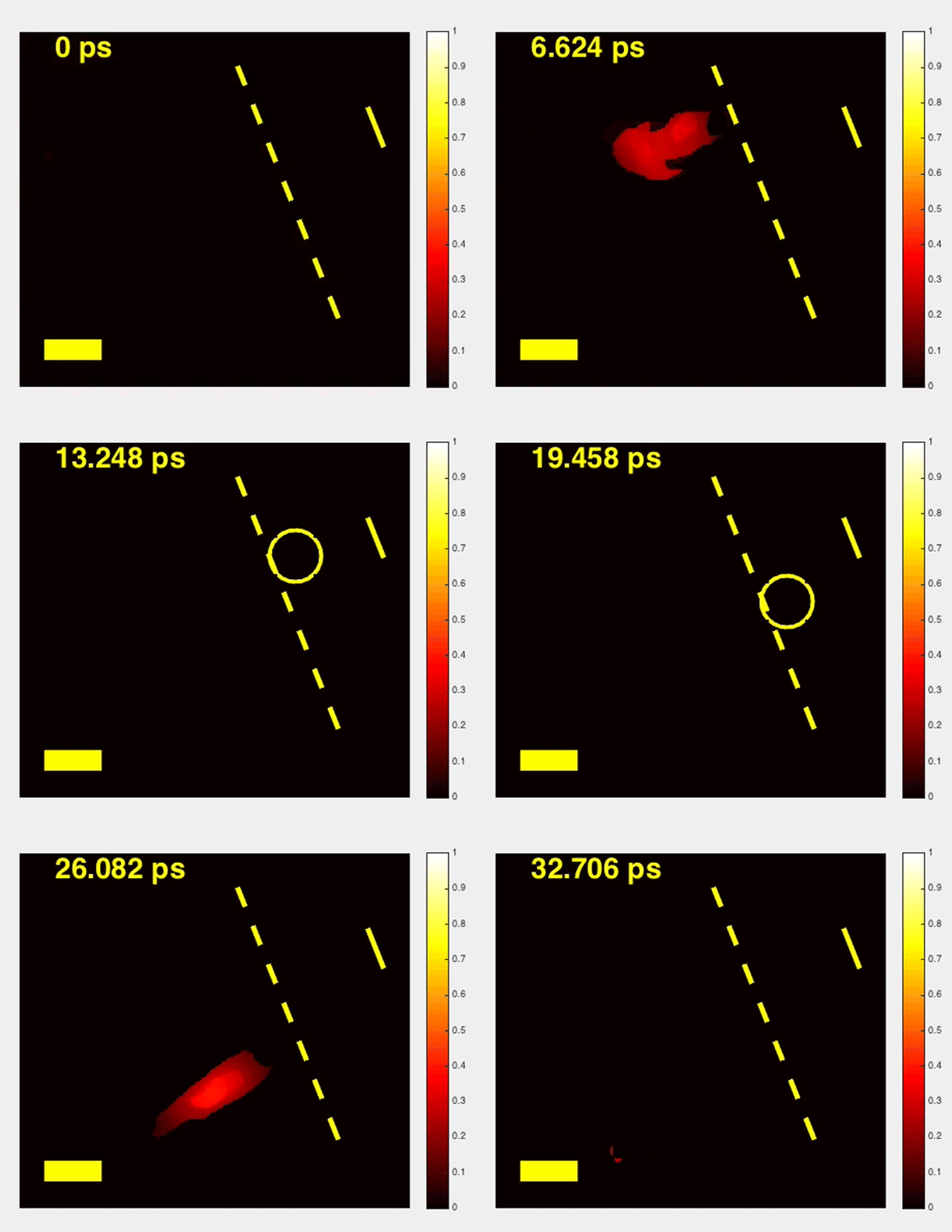
In a separate experiment, the team made a 60-frame video showing a light pulse leaving the material and then being reflected back in (see video above); this video required 414 femtoseconds between frames in order to observe all of the action.
The researchers hope that ultra-fast imaging can be more easily used in a number of applications like inspecting biological samples in laser surgeries and imaging-based disease diagnosis.

COMMENTS