


Maxim is aiming at charging lithium-ion or lithium-polymer cells from USB Type-C sources with the MAX77860 switch-mode (2 or 4MHz) buck char
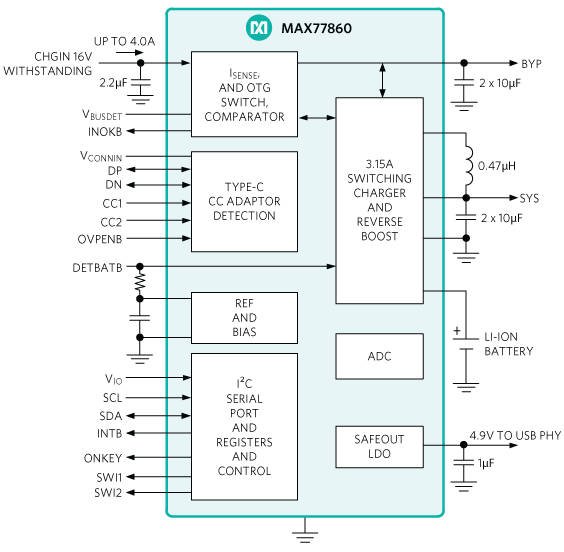
Maxim is aiming at charging lithium-ion or lithium-polymer cells from USB Type-C sources with the MAX77860 switch-mode (2 or 4MHz) buck charger that can flip direction, becoming a boost converter to power 2A USB on-The-Go loads using the same inductor.
Meanwhile, it also powers a load, either from the external power source or battery.Inputs can span 4V to 13.5V, and there is protection from input over-voltage up to 14V, according to Mouser, which is stocking the part.
The data sheet agrees with these figures on its front page, then goes on to state 3.2V to 14V input, and 16V withstanding later (diagram page 2, text p33).
For use with differing adaptors, there is a 0 to 4.0A input limit (programmable in 33.3mA steps). As well as user-definable power sources, specific power sources supported (via USB D+/D- auto-detection) are: Charger Downstream Port (host or hub), Apple (500mA, 1A, 2A, 12W), Samsung 2A, USB 2.0 Low Power (100mA host or hub) USB 2.0 High Power (500mA host or hub).
There is “support for USB Type-C CC [BC 1.2 spec] detection with reverse boost capability to power USB On-The-Go accessories. The charger includes two integrated switches and a single input for both USB and high-voltage adapters,” said Mouser.
An on-board algorithm regulates output constant current (battery charge limit is 3.15A), output constant voltage, and die temperature, while the chip’s ADC monitors battery voltage, charging input voltage, charging input current, battery temperature, and charging current and discharging current.
In I²C bus allows programming to account for different system loads and battery sizes
As well as current, voltage and temperature limits, there is a charge timer and a , watchdog.
Packaging is 3.9 x 4.0mm, 81-bump (9 x 9 array), 0.4mm pitch, wafer-level (WLP).
Despite the small size, low-ds(on) devices are used inside – drop-out
resistance from adapter power input to the battery is typically 150mΩ (assuming 0.04Ω inductor ESR) – which allows 3.15A charging from a 5V supply.
Support comes from an evaluation kit, which includes a MAX77860-based charger board with integrated I²C interface, and MINIQUSB communication device.
Applications are expected in portable equipment including: medical, industrial and point-of-sales, as well as phones and IoT devices.

COMMENTS